Thermal Imaging Leak Detection
A thermal camera finds the wet zone in a Smyrna wall or ceiling before we open anything. Temperature differences from moisture show clearly on the infrared image.
Call (770) 214-4545 | 24/7Licensed in Georgia | Cobb County | (770) 214-4545
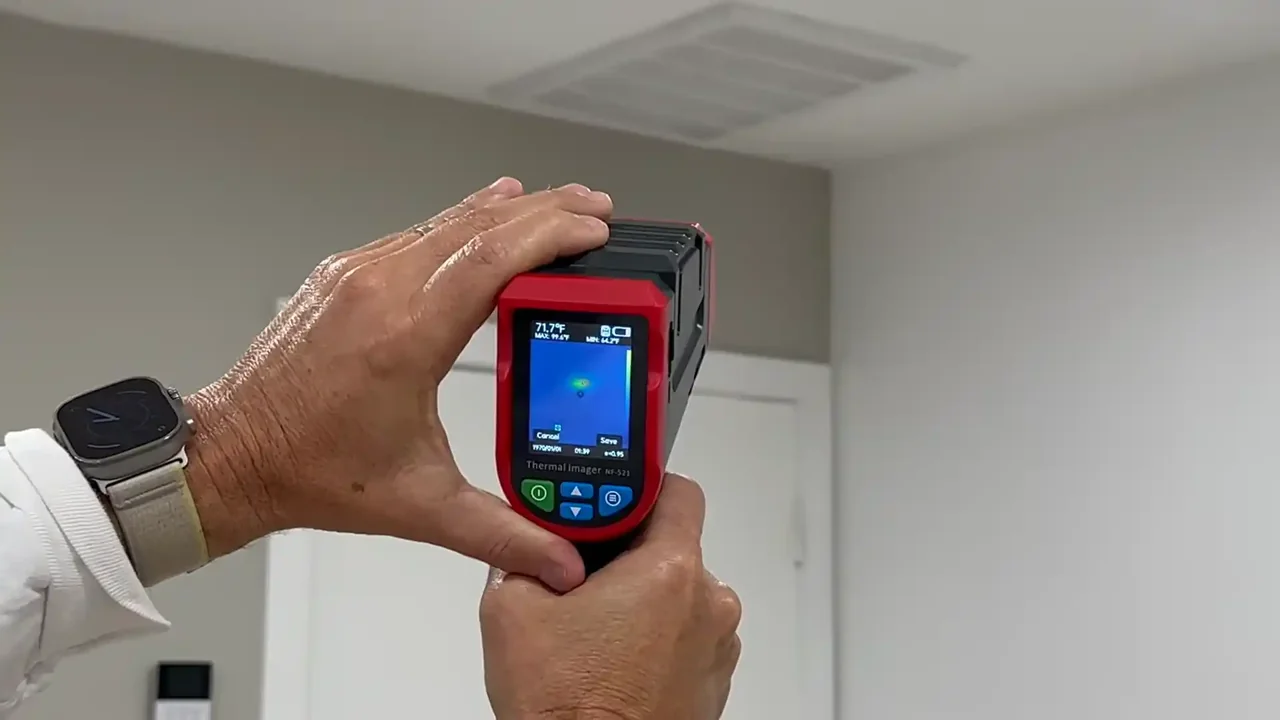
Thermal imaging leak detection uses an infrared camera to detect temperature differences on surfaces that result from the presence of moisture or from water actively flowing through a pipe. Because water has different thermal mass and thermal conductivity characteristics than dry building materials, a wet area in a wall, floor, or ceiling produces a measurable surface temperature difference that the thermal camera captures as a visible contrast in the infrared image. This allows us to identify moisture locations behind finished surfaces without contact or any physical opening of walls or ceilings.
How Thermal Imaging Works
The thermal camera detects infrared radiation, which correlates to surface temperature. Dry drywall, wood framing, and insulation all have characteristic thermal profiles. A wet framing member or saturated insulation holds temperature differently than the surrounding dry material. When a supply line leaks cold water behind a wall, the wet zone is cooler than the surrounding dry wall surface. When a hot water supply line leaks, the wet zone is warmer. In both cases, the camera produces a thermal image where the wet zone appears as a distinct temperature anomaly against the surrounding surface.
The optimal conditions for thermal imaging in a Smyrna home are a temperature differential of at least 10 degrees between the water source temperature and the ambient room temperature. In summer, cold water leaks are easier to image because the supply water temperature is significantly cooler than Smyrna's indoor ambient temperatures. In winter, hot water leaks are equally easy to image. We plan thermal inspections around these conditions and, in ambiguous cases, run both hot and cold supply systems to maximize the thermal contrast available.
How We Apply This in Smyrna and Cobb County
Thermal imaging is the primary tool we use for leak investigation behind finished surfaces in Smyrna's basement homes. When a ceiling stain appears in a basement directly below a first-floor bathroom, we scan the bathroom floor and the visible ceiling structure with the thermal camera before opening anything. The thermal image identifies the wettest zone in the floor structure, which is often offset from the visible ceiling stain below due to water migration along joists, and tells us exactly where to open the ceiling for the most direct repair access.
For Smyrna shower leak investigations, thermal imaging of the shower wall surface during and immediately after an active shower reveals whether moisture is present in the wall cavity behind the tile, and which section of wall is wettest. This prevents the common error of opening the dry wall behind a shower looking for a valve body leak when the actual source is a tile grout failure on a different wall section.
Thermal imaging detects the effect of moisture on surface temperature rather than the sound of water escaping under pressure, which distinguishes it from acoustic detection. The two methods are complementary: acoustic detection is stronger for finding the exact pipe breach point, while thermal imaging is stronger for mapping the extent of moisture in building materials and for detecting leaks that have been running long enough to saturate wall and floor assemblies.
Need thermal imaging for a leak in your Smyrna home? Call for same-day service.
Call (770) 214-4545When We Use This Method in Smyrna
We use thermal imaging in Smyrna as the first investigation tool for ceiling stains, wall stains, and floor moisture symptoms where the leak source has not been identified. It is the preferred method for shower leak investigation, bathroom floor moisture mapping, and determining the extent of water damage in floor and ceiling assemblies after a pipe failure. Thermal imaging is less effective for active underground pipe leaks where the surface above is not exhibiting a temperature anomaly from the leak below.
Frequently Asked Questions
Related work often surfaces during the same visit. We also handle acoustic correlation to narrow the location after thermal imaging confirms a hot spot and can assess slab leak detection using thermal imaging on heated supply lines at the same appointment in Smyrna.
Yes, with conditions. Ceramic tile has moderate thermal conductivity and transmits temperature differences from moisture in the wall cavity behind it to the tile surface. The temperature differential needs to be large enough to produce a measurable surface signature. We run hot water through the shower before scanning to maximize the thermal contrast, and scan the wall surface both during the shower and immediately after it ends to capture both active-flow and residual-moisture signatures.
Summer conditions in Smyrna are actually favorable for cold-water leak detection. The ambient indoor temperature of 72 to 75 degrees combined with a 60-degree cold supply creates a 12 to 15 degree thermal contrast that shows clearly on the infrared image. Hot-water leak detection is slightly less effective in summer because the temperature differential between the hot supply and the ambient is smaller than in winter. We adjust scan timing based on seasonal conditions.
Yes. The thermal camera displays a live infrared image that we review with you on-site. We can identify suspect zones immediately and discuss findings as we scan. For complex situations, we capture still images and video for review and documentation.
No. Thermal imaging is completely non-contact and non-destructive. The camera detects naturally emitted infrared radiation and applies no energy or radiation to the surfaces it scans. It does not affect building materials, electronics, or any other objects in the space.
Questions about a leak in your Smyrna home? Call anytime.
Call (770) 214-4545